
– updated September 2026
Metaphorically, Oneness is like a film running so rapidly that no frames are visible – until it slows down. Only then do separate frames emerge, thereby seeming to confirm more than one

We recognise certain letter combinations as meaningful. And arranged on a screen, as here, we assume we’re reading something authored by someone else. Hence, we conclude that we’re in a world with more than one. But nobody actually sees someone else’s writing. We encounter only our own interpretation. Hence, there’s nobody but One.
From Duality Hack #9.9 in the free eBook Alexius’ Duality Hacks.
The fantasy of more than one
Imagine an infinite flurry of letters always racing so fast they fuse into One. Then slow the pace of Oneness, and the letters become distinct, each taking its own form, as if there were more than one.
Next, imagine these distinct shapes are mingling over time to form innumerable combinations, each assigned a specific meaning. This seems to ratify a world divided by space and time, while questioning the formlessness of Oneness.
Thankfully, we can easily undo this time-and-space fantasy, which is maintained by keeping thoughts separate. If we don’t prevent thoughts from racing, they blur together, leaving no time for division to take root.
If you need a moment to process this, it’s not because you want to understand it, but because you want to actively slow the pace of your thoughts, making them seem to affirm that separation is real and Oneness is unreal
The infinite speed of oneness
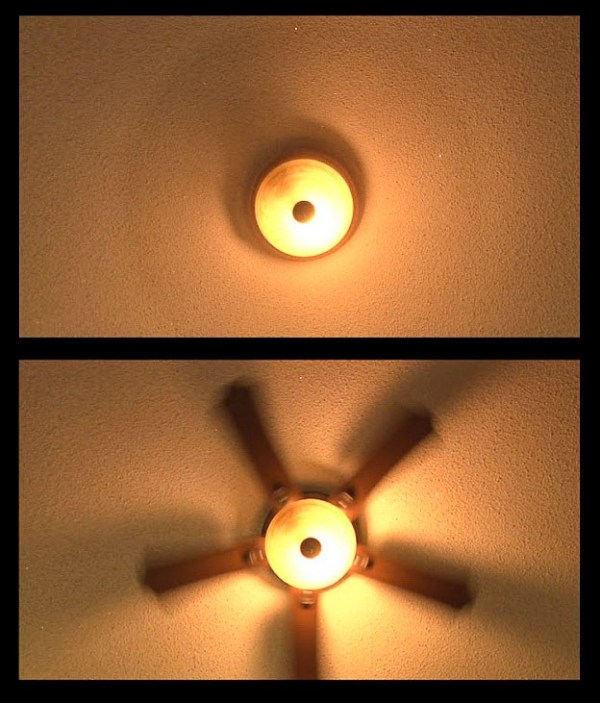
Everything moves infinitely fast in that which is One. Hence, there’s no separation, as in the first image, where the ceiling fan’s extreme speed obliterates division. But when you slow the fan down, distinct blades emerge. Similarly, a world with more than one appears when we imagine slowing down Oneness’ infinite speed.
That which is One versus a world with more than one
Oneness can be likened to a film played so fast that its frames vanish. Only when the film slows do individual frames appear, seemingly confirming a world of more than one and denying that which is One.
In this context, slowing down our experience of more than one does not undo our belief in a world with more than one. Instead, as thoughts form your experience of more than one, don’t prevent them from speeding up. The faster they race, the less the film frames differ, and the less you perceive a world with more than one.
Thoughts automatically run faster when you don’t shape them into interlocking Lego bricks, building an appearance of you as someone in a world with more than one. Left unshaped and unbound, thoughts speed sparks a take-off into the empty breath, bringing you to a state of not-knowing.
In this state, your slate is wiped clean, so when you return to the conscious experience of a world with more than one, you are not conditioned to believe it is real. You still appear as someone in this world, yet not of it. This freedom may lead you to welcome the Enlightenment of that which is One, revealing that there never was and never will be anything but one perpetual present.
The Ukrainian pianist Lubomyr Melnyk plays at breathtaking speed, spinning elaborate patterns that produce hypnotic overtones. The resulting sound is so captivating that you forget it is the speed that sparks the magic.

The same applies when you worry and don’t try to appease yourself, but instead step into the full, uncontrolled speed of anxiety, provoking a take-off into the empty breath.
Epilogue
Halting or slowing your thoughts leads to a motionless mental state. This numbness, often mistaken for stillness, has nothing to do with Oneness. It’s not deadlocked but free-flowing energy, moving so fast that it becomes shapeless – fluid, formless, and limitless.
So, if you wish to undo the belief in more than one, don’t slow down thoughts. As they reach immense speed, they blur together, erasing any sense of division, thus uncovering that which is One.
Leave a Reply